
|
HEARTBREAK TOIL In the semi cleared jungle the prisoner-labourers toiled. You spent labourious hours digging out earth with shovel and pick and removing it in small hand baskets.. Backwards and forwards went the gangs tipping the basket loads on the embankment until it grew steadily in width, length and height. A metre of earth by each man each day; that was the first Jap order. But before long the required measure increased; a metre and a third, a metre and a half.....It became more and more difficult to keep pace with the orders. Our British Officers tried repeatedly to get the daily stints reduced, but it was no good. The Japs were insatiable; they were going to get what they demanded, whatever the cost. The inadequate food provided by the camp authorities resulted in streams of prisoners going into the so-called hospital block, but the treatment was as bad as ever. More lives were forfeited. It was clear as time went on that the Japs simply did not care what happened to prisoners as long as the railway was completed. Get on with it; get on with it; that was the incessant call, thudding into the wind, sapping the sinew. The camp cemetery expanded as the ranks of the prisoners thinned. But though fewer men worked, the routine had to be kept up. Sickness was no escape. Men must keep going till they dropped. Little wonder that some began to lose heart and feel that ours was a lost cause. The ruthless Jap camp Commandant refused to face the truth that there is a limit to the output of overworked, underfed serfs. As he became more fanatically insistent, the guards became more wrathful. When the work was not progressing as the Japsmasters expected, physical punishment was meted out by rifle butt or any hard implement that might be handy. Guards sometimes smacked our faces viciously from side to side until the senses reeled. Yet in spite of all this treatment, some of us still had enough reserves of strength to endure. My muscles tightened like whipcord, as those of others did. Our bodies were free of all superfluous flesh. But sometimes malaria and dysentery struck us down with appalling results. It was not unusual for some to suffer both illnesses at the same time. Our plight in those primitive conditions was then sickening. Men in pain crawled to the latrines in the darkness to find them already overcrowded. The sight of maggots which swarmed there would have been revolting to the fit, let alone the sick. We would crouch Oriental-style over the slit trenches. This seemed to antagonise the bats, which often whirred around the head and between the legs, as if outraged by our presence. The feel of these nauseous creatures bumping into the body was shattering beyond words to any man of sensibility. Shovels and picks biting into the scorched earth; more and more baskets of brown earth carried over to the growing embankment; more and more brown earth, earth that builds, earth that destroys, earth that buries; the endless remorseless trail. Yet the mind was still alert enough at times. It was the practice to build many small wooden bridges over the culverts. This gave us the chance to show that we still had guile enough to think out ways of reducing the physical strain and contributing a little sabotage at the same time. The war was still on, and we could do our bit against the enemy. Saplings and trees, felled by the score as the trail was blazed for the railway, lay alongside the track. They were excellently suited for pilling between the outer walls of the embankment and the culvert woodwork. Trees helped to fill up fairly large holes here. As guards snatched sleep under some shady tree, we would hastily move trees to the embankment; then all hands would work feverishly, bringing baskets of earth to cover up the trickery. The work demanded care. Branches not properly covered would have told their own tale. A gentle pounding and a gradual levelling off were needed to disguise what lay under the embankment. These opportunities did not come often, but when they did we took a mischievous pride in glancing at our handiwork as we marched past the culverts day by day. There were subtle jokes and veiled references. Each one of us fervently hoped that when the first train came through it would crash on a sinking track. Unfortunately, I never heard of any such occurrence, but at the time our efforts helped enormously to buoy up our spirits, and there was always the chance that parts of the track deliberately made weak would eventually embarrass the Japs. When I worked at Chungkai some of the Thai natives began visiting the railway working sectors about lunch-time. They used to set up their cooking stoves there and sell fish and eggs to prisoners who had money to spend. On a small wooden fire they cradled their bowl-shaped cooking utensils, poured in oil, and cooked small fish - what kind I do not know, but the fishes were about the size of a small herring. I have a vivid recollection of one old woman, with wizened skin, who came daily to the embankment to do her cooking. Her ugly mouth was stained from betel-nut chewing, and she spat often as she crouched over the fire and turned the fish in the cracking fat or basted the eggs. Occasionally she would open her deep red mouth, revealing toothless gums, as she smiled at prospective customers. By that time, like others, I had become hardened to many indignities; but much as I longed for her savouries, as the smell of cooking fish rose in the dusty air, I could never bring myself to buy from her, although those who overcame their scruples about her cooking manners seemed to enjoyed her cuisine enormously. If we had the energy left now, we used to bathe in the nude in the river. Often the Thai river people passed in their pom-pom boats, small but powerful craft, usually pulling barges of varying shapes and sizes. Aboard the boats there were Thai womenfolk, who at the sight of our bodies would break into good humoured banter, laughter, giggles and gesticulations. It all seemed good fun to them. We could make nothing of their language - although signs and looks transcend the language barrier- but their presence helped to introduce a strain reducing element into our lives. Flying up and down the river, their only home a boat, these good-natured people were a welcome sight to us. It was good to remember that we, too, could still laugh, that the faculty had not withered. I suppose some of us, splashing about feebly, looked ridiculous to them. We were not all born to the water, as they were. The river people would take their babies, some only a month or two old, into the water, teaching them not to be frightened of it. The father, gently cradling the child in the crook of an arm, would swim close to the river bank, scooping water on the baby's head. As a result of such early baptism, the children on the river craft became expert swimmers. They could swim with ease and grace almost as soon as they could walk. The first time I ever saw the "butterfly" stroke was here. The boys were also remarkably clever at underwater swimming. On the river's bank of an evening I would sometimes watch them gambolling around in the water. Suddenly one of them would disappear in a dive. I used to try to work out where he would re-surface, but I was always wrong. His head would pop up a long time afterwards - a long way from where he had gone under. It was good to see human beings at play, it helped to keep one sane. After recovering from a bout of recurring malaria at Chungkai I was put on light duties for a time. This entailed working in the allotments just outside the camp. Nearby was the tenement of a local farmer and his huge family. His cattle, I remember, were scraggy, bony and underfed; they used to remind me of ourselves. There was little grass on the arid ground. It was here that one day I watched one of the cows give birth to a calf. It lay on the ground for several hours after the mother had cleansed it, and got no attention. It tried repeatedly to get to its feet, but when its back legs were in the right position it had not enough strength to force its front one's up. The cow, a lazy, remarkably lop-eared specimen, seemed unconcerned; sometimes it would nose under the calf's belly, as if trying to help, but it quickly tired and left the calf to its own efforts. All that day the calf struggled to get a footing, but it was well into the next afternoon before it was able to lurch, drunkenly, towards the cow and suckle. It had earned it. The Chungkai guards used to spend their evenings off duty in the nearby town of Kanburi. I am no expert on this, but I understand the brothels there did flourishing business with Jap and Korean patronage. There were, possibly, varying views on the matter, but most of the prisoners seemed too weary to worry about sex. We had passed the barrier into the sexless land by now. Speaking for myself, I had only the strength necessary to work all day and stagger thankfully at night to my bamboo bed. The railway continued to march on. After a section had been completed by one camp the labour units set off for new sectors farther in the interior. Our section eventually found itself in a camp where the engineers required labourers to surmount the difficulties of steep, white-rocked terrain overlooking the river. A long level stretch had to come out of the perilous rock face. Pneumatic drill gangs were set to work boring holes for the gelignite charges. It was an exceptionally hard job and dangerous too, as we perched precariously on the ledges, with a deep drop to the river. The Japs insisted that we went on working after dark in the glare of acetylene flares. Dust caused by incessant drilling into the rock and the reluctant blasting left an acrid taste in the mouth and throat. We parched our thirst with chlorinated river water. The Jap engineers, aided by their faithful guards, forced the pace. Eventually we completed a levelled rock surface wide enough to take single-line traffic along the cliff face. 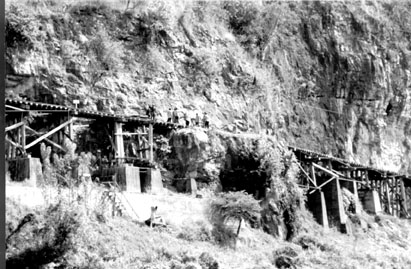 We marched on to another camp. Eight months of sweat and soil were now behind us. Yet the labour battalions were still forced to carry on. At one camp where bridge building was in progress I had to work for a time for a tiny, but strongly-built Jap engineer. He was kind and considerate and one of the best of his race I even encountered. He used to give me bits of vegetable and pickle from his tiffin box during the mid-day break, as well as a cigarette or two. He tried to learn some English words from me and I had a shot at the Japanese equivalents. When he showed me photographs of his wife and three children, he looked at them longingly; I made out from his words and signs that he had not seen his family for seven years. He had been campaigning elsewhere for a long time before he was drafted to Thailand. I showed him a photograph of my wife and son. "Okay, okay", he commented, with a smile. "Goodo, goodo". I worked with him, trimming and cutting tree trunks into the required shape and length for the uppermost part of the bridge which would eventually carry the track. One day he left us to work alone while he returned to camp for tools to take the place of two that had broken during the morning. As I worked, another Jap came along and began to question me. I could not understand him, nor could he make out anything I said. He bellowed and bawled and pushed me around. I repeatedly tried to explain that the engineer had returned to camp for tools, and picked up the damaged axe and pointed in the direction of camp. He became more and more infuriated. He picked up the wooden shaft that had become detached from the large axe-head. He struck me with it about the head and shoulders. I tried to shield my head with my arms, which felt the full force of the blows. He continued shouting as he beat me, and then gave me a kick in the pants. Fortunately, he was wearing the Jap-style ankle boots of canvas with thick rubber soles. I must have lapsed into unconsciousness. When I eventually came round, I had a splitting headache and my shoulders and arms felt badly bruised. I was forced to lie there for some time until I mustered enough strength to get up. I tried to restart my cutting job, but had to drop on to a log, holding my head between my hands. I trembled and then vomited. After that I felt a bit better. The little engineer on his return was obviously concerned about my appearance. In pidgin English and by gesticulation I tried to tell him what had happened. He allowed me to sit at the foot of a tree for the rest of the afternoon until it was time to return to camp. On the return journey we met the Jap who had beaten me up. I told my companion this was the man responsible and he strode jauntily up to him and rebuked him. Bruises or no bruises, I had to work again the following day, but I was transferred to another party. I never saw the amiable little Jap again. Perhaps he caught it in the neck for speaking up on my behalf. I never knew. It was days before my bruises eased. The march to the next camp was, I remember, agonising. We camped several nights by the roadside, completely exhausted. Our destination turned out to be a desolate spot; a flat plateau alongside the river, again ideal for river craft bringing up supplies. The tents we had hauled with us on the long journey were pitched and we lived in them for several weeks until we could put up bamboo huts. Day after day we cut bamboo, carried it back to camp, and split it up for the new buildings. It was monotonous, but a welcome change from the more exhausting railway work. The monsoon winds blew harder and harder, raising the dust in bitter choking clouds, and we were glad when at last we could store away the tents and turn to our new bamboo quarters. As soon as the huts were up, other workers joined us. It was while I was here that I had a particularly sharp attack of malaria followed by that most distasteful ailment, jaundice. I was convalescing with several others in the hut. None of us was even remotely fit for work of any kind, but the Japs decided that a dozen men were needed for "light duties" around the camp. The order was rapped out - "you, you and you". I was one of the "yous". We had to get up and report to a Jap guard at the riverside landing stage at the bottom of a slope. I was still bemused with the jaundice and the fading fever and doses of powdered quinine washed down with filtered river water. For days I had eaten little; the smell of cooked rice being sufficient to turn my stomach over. We were needed for rice-humping fatigue. We were ordered to carry 100 kilos of rice in sacks from the river boats to the camp stores. Without any load, the walk of about 300 yards would have been enough to exhaust all of us in our present condition, for the slope was steep. As we lined up I was in the middle of the fatigue party. Rice sacks were humped onto the shoulders of the first five. Their legs and backs sagged as they shifted the weight to get the sacks securely wedged on their bony shoulders. Then it was my turn. My head was swimming and my legs wobbly, but I tried to brace myself to receive the load. There were about 220 lbs. of it. As soon as it was on my back I crumpled and slithered to the ground, the sack pressing my face into the scorched sandy soil. The guard rapped out a testy command to me to get up and get the load on my back again, but I was unable to rise without help. Two of the fatigue party pulled the weight from my body and somehow I got to my feet. The sack was reloaded on my shoulders and I staggered off. The 220 lbs. felt like a ton and my muscles seemed to be made of jelly. I managed to go about 20 yards, and then had to let the sack drop and sink to the ground again. I was sick and miserable, but I was given no chance to recover. The guard, a tough, sinewy man about five feet tall, bounded up and, growling oaths, kicked me on the backside. Then he dragged me to my feet. I swayed, dully expecting a backhander across the jaw, but it did not come. The guard looked me over and must have decided all this was a waste of time. "No goodie" he said, with an expression of disgust. I was not, however, completely "no goodie". He took me back to the loading bay, and ordered me to carry sacks half the weight the others were carrying. I set off again with a sack of 50 kilos or so, dragging my weary body up and down the slope from river to camp and camp to river. There was no relaxing. It went on for several hours and in the end I was doing the fatigue with the action of a slow-moving, slack-springed clockwork toy. In the late afternoon I was allowed to go to my bed of bamboo slats. I think that by that time I would not have cared had it been a bed of iron spikes - provided it was flat. After a night's rest there were two more days of "light fatigues" to face. When they were over, I was declared fit to return to more arduous duties. We had built our new home. Now the call to the railway came again. The breathing space was over. The monsoon winds were now tearing through the valley and the rain came in their wake. There was an incessant barrage from darkened skies, and conditions got worse as the days went by. What boots and clothing some of us still retained were hopelessly tattered. Most went without boots and without clothes. Scores wore only a small piece of material - a G-string, Jap style - round the loins. Skins, burnt by the strong sun before the monsoons, had turned from white to dark brown. Many of us could have passed as natives - but any thought of escape was pointless. Some men had tried, but limited equipment and resources had inevitably led to their recapture. They were no longer with us; death at the hands of a shooting party was their final escape from drudgery. Even in the face of all this, the indomitable "Hockie" again began to talk about escape, like a man obsessed by visions of a distant shore. He still carried with him a map of Malaya, Thailand and Burma; it was one torn from a school atlas in Singapore, and hopelessly inadequate for the terrain and forests in which we now found ourselves. However much I admired his courage, I was glad when his escape fever spent itself again. He must have gone the way of the others who tried. Perhaps, too, he remembered the four Britons who were brought into camp one day at Chungkai after an escape attempt which failed. That night they were allowed anything they wished to eat - by that was meant anything the cookhouse could supply; a beggar's banquet indeed. Just after dawn the next morning shots rang out from the firing squad. I learnt that before being shot the four men had had to dig their own graves. Afterwards, a party from the camp went outside to bury them. Four little mounds of earth and headstones taken from the rocky slopes nearby marked their last resting place. We always passed the spot as we marched to and from the railway. I am not ashamed to say that those graves always brought a lump to my throat and a prickly feeling behind the eyes. How many times, seeing them, have I silently mouthed the words "God rest their Souls!" - followed by "Those bloody, bloody Japs!"
|